What is sales intelligence? A guide for B2B sales teams
Most teams already own plenty of contact data. What they lack is a record of what buyers said on their own deals. What sales intelligence covers and how to roll it out.


Updated 15 October 2026.
Sales intelligence overview
- Sales intelligence is the data a sales team uses to decide who to contact, when, what to say and what to do next on each deal.
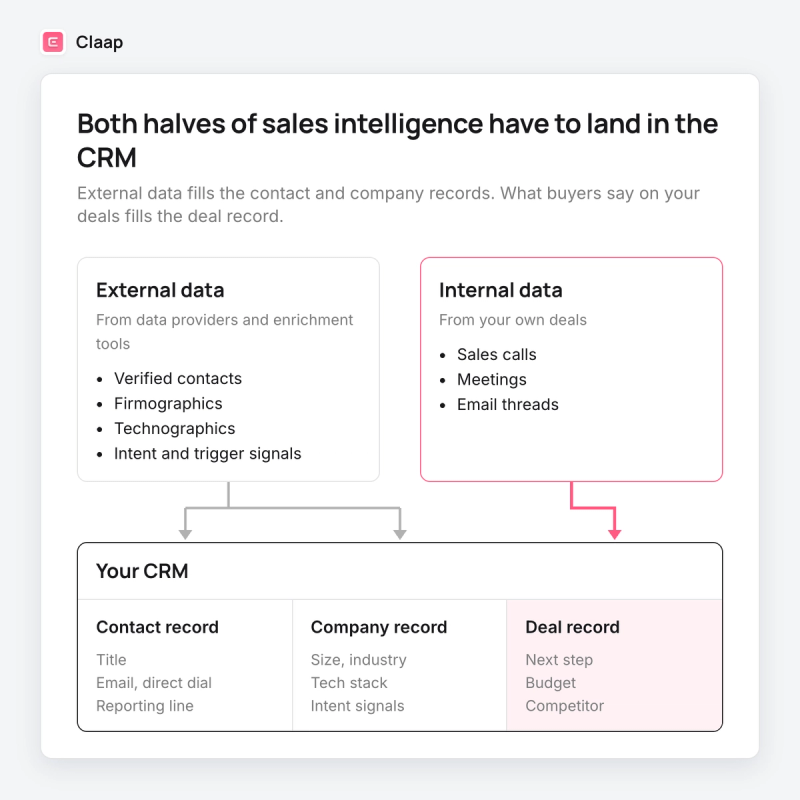
- It comes in two halves: external data about prospects (contacts, company facts, intent signals) and internal data from your own deals (what buyers said on calls, meetings and emails).
- External data helps you find and open accounts. Internal data tells you why a deal moves, stalls or dies.
- Automated sales intelligence uses software and AI to collect both halves and write them into the CRM fields your team already reports on.
Most teams that buy sales intelligence already own plenty of contact data; what they lack is a record of what buyers said on their own deals, so that is where the next dollar should go.
The tooling is rarely the issue. In a Bain & Company survey of more than 1,200 senior commercial executives, more than half said they had not built adequate data foundations, and they named incomplete or low-quality data first (Bain & Company).
On our own sales calls, buyers who already pay for contact data told us the same, so this guide starts with what they said is missing, then covers what sales intelligence is, the data behind it, how to roll it out and which tools cover which part.
Sales intelligence at a glance
| Data | What it tells you | Where it comes from | Main limit |
|---|---|---|---|
| Contact and company data | Who the buyers are, company size, industry, tech stack | Data providers and enrichment tools | Goes stale as people change jobs |
| Intent and trigger signals | Which accounts are researching a topic or just changed (funding, new leader) | Website visits, review sites, news, third-party intent feeds | Shows who might be in market; the reason comes out in discovery |
| Conversation data | What buyers said about needs, budget, timing, competitors and next steps | Recorded calls, meetings and email threads | Useful only once it reaches the CRM |
| Deal and competitive data | How deals are won and lost, and against whom | CRM fields, win/loss reviews, call data | Needs enough deals to show a pattern |
Teams with contact databases still lose what buyers say
We went back through a year of sales calls recorded in Claap and kept the buyer teams that said they already pay for an external contact or enrichment source: Apollo, ZoomInfo, LinkedIn Sales Navigator, Lusha, Cognism, Kaspr or Clay.
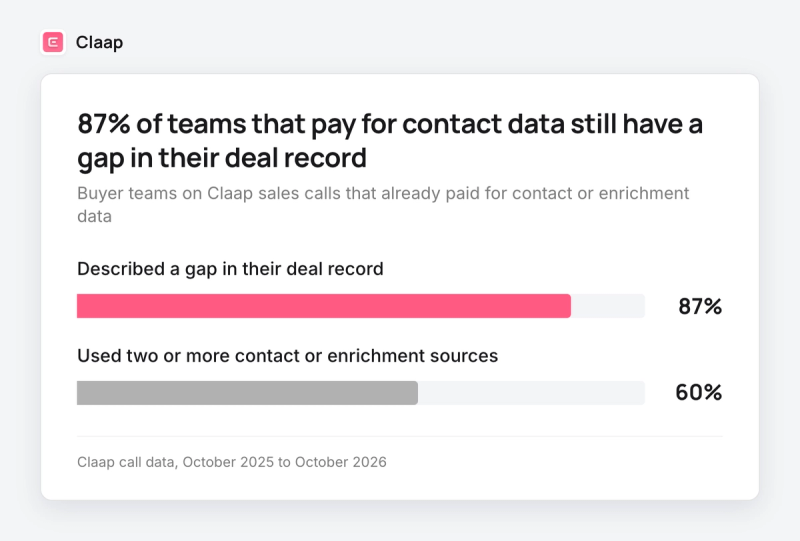
- 87% of those teams described a gap in their own deal record: call notes typed by hand or never, qualification fields left empty, meetings stored in a tool the CRM can't see (Claap call data, October 2025 to October 2026).
- 60% of them paid for two or more external data or enrichment sources, and the gap was still there (Claap call data, October 2025 to October 2026).
In their own words:
- "Between lemlist, Clay, Apollo, on how to identify and lead-score, we're about fine." Then, a few minutes later: "There is follow-up, but we lose the key details about the people we talk to." Head of outbound, marketing technology company (translated from French).
- "Mandatory fields at the end of a call... the rep doesn't have time because he has to go to another call. And in the end, it doesn't get done." Head of business development, logistics software company (translated from French).
- "We have to go to Apollo to find the meeting, and it's not in Hubspot." Go-to-market operations lead, infrastructure software company.
- "There is both a methodology problem that we need to correct with enablement, and also, let's say, a laziness problem. Of logging the right information inside Hubspot and putting a nextstep." Revenue leader, communications software company.
A fair limit on these numbers: the cohort is small, so read them as a direction, and these are teams that booked a call with a conversation intelligence vendor, so they lean toward this problem. The finding is narrower than "most teams have a deal-record gap". It is that paying for contact data, even from several providers, did not close the gap for the teams that had it.
What this means for your budget:
- Fix the deal record before you buy another database, because a new contact source adds rows to a CRM whose deal fields are already empty.
- Use your current provider for one more quarter if its bounce and connect rates are acceptable, and spend the review on what happens after the first meeting.
What is sales intelligence?
Sales intelligence is the practice of collecting data about prospects, customers and deals, turning it into signals, and acting on those signals in the tools reps already use.
Take two account executives working the same list of target accounts. Both have the same contacts from the same provider. The first one opens the next call by asking the champion to repeat their priorities. The second one opens with the budget range and the competitor the buyer named two calls ago, because it is in the deal record. Same external data, different internal data, a very different call.
Sales intelligence vs a CRM
A CRM stores contacts, companies, deals and activity. Sales intelligence fills those records with fresh facts and signals, and tells reps what to do next. The CRM is where sales intelligence has to land; a signal that lives in another tab is one nobody acts on.
Sales intelligence vs conversation intelligence
Conversation intelligence records and analyzes sales calls and meetings, then extracts what buyers said: pains, objections, budget, timing, competitors. It is the internal half of sales intelligence. Prospecting databases are the external half. Our guide to conversation intelligence software covers that half in detail.
Sales intelligence vs revenue intelligence
Revenue intelligence applies the same deal and call data to the pipeline and the forecast: deal risk, stage movement, forecast accuracy. Sales intelligence starts earlier, at prospecting and qualification, and both read the same records.
The two halves of sales intelligence data
External data: who to contact and when
- Firmographics: company size, revenue, industry and location.
- Technographics: the tools a company already runs, useful for displacement and integration pitches.
- Verified contacts: emails, direct dials and reporting lines of decision-makers.
- Intent and trigger signals: pricing-page visits, review-site research, funding rounds, leadership changes.
External data decays as buyers change roles, and intent data says who might be in market without saying why. Treat every signal as a reason to start a conversation, then confirm it in discovery.
Internal data: what is happening on your deals
- What buyers say: pains, goals, budget, decision process, timeline and the tools they compare you with.
- How deals move: next steps agreed, objections raised, stakeholders who join or drop off.
- How reps sell: questions asked, and whether the team follows its qualification method, such as MEDDIC or SPICED.
- Competitive patterns: which rivals come up, at which stage, and why deals are won or lost against them.
Your team produces this half on every call at no extra cost.
How automated sales intelligence works
Automated sales intelligence runs the jobs a sales ops analyst would run by hand, continuously:
- Enrich: pull contact and company data into CRM records and keep it current.
- Detect: watch for buying triggers such as a pricing-page visit, a funding round or a new executive.
- Capture: record calls and meetings and extract what buyers said.
- Write back: put both into typed CRM fields (next step, budget, competitor, qualification criteria) and alert the owner.
The last step decides whether the rest pays off. AI agents and reports read CRM fields; an agent working from a deal with an empty next step and no competitor field gives generic advice, however good the contact data behind it.
How to roll out sales intelligence
- Start with your own conversations when your team already runs discovery and demo calls every week, because that data already exists and costs nothing to collect. Record the calls with the buyer's consent and decide which five or six deal fields every call should fill.
- Pick tools that write typed values into the CRM fields you report on, because a summary note on the activity timeline can't be filtered, scored or forecast.
- Choose your contact data provider by testing it on your own target accounts, because coverage varies by region and segment. Track bounce rate, connect rate on direct dials and record age before you scale a play.
- Give every signal an owner and a deadline. Write each rule as: if this signal, then this action, by this person, within this time. A competitor named on a late-stage call goes to the account executive before the next call; funding news at a target account goes to the SDR the same week.
- Skip default alerts that nobody acts on, and review the rules monthly with sales managers. Retire any signal that never led to a meeting.
This advice is wrong if you are building outbound from zero with few conversations yet: then contact data and intent signals come first, and call data follows as meetings come in.
Tools for sales intelligence
Most teams assemble sales intelligence from a few categories of tools, and no single vendor covers every layer:
- Contact and company data: databases such as ZoomInfo, Apollo or LinkedIn Sales Navigator.
- Enrichment and signal orchestration: tools such as Clay that combine providers and trigger workflows.
- Sales engagement: platforms such as lemlist or Outreach that run multichannel sequences.
- Conversation and deal data: tools such as Claap or Gong that capture calls and turn them into deal data.
For a side-by-side comparison, see our list of the best sales intelligence tools.
A quick note: Claap is our product. To keep this guide fair, we linked every outside claim to its source and labeled our own data.
Claap covers the internal half. It captures your calls, meetings and emails, then writes what buyers said into HubSpot or Salesforce fields with CRM auto-complete: next step, budget, competitors and qualification criteria, without overwriting what a rep already typed. Deal risks dated to the call show up in saved views such as at-risk opportunities (revenue intelligence). Claap has no contact or company database, so it pairs with a data provider for prospecting; lemlist, which Claap is part of, covers that side. CRM writing is on the Business plan, at $60 per seat per month billed yearly (Claap's pricing page), and Claude or your own agents can read the same data through the Claap MCP on every plan, the free one included.
How to measure sales intelligence
Set a baseline before rollout, then track the same handful of numbers every week:
- Deal record completeness: share of open deals with next step, budget and competitor filled at each stage.
- Conversation-to-opportunity rate: share of first calls that become qualified opportunities.
- Stage conversion and cycle length, by segment.
- Forecast accuracy: gap between committed and actual revenue.
- Signals acted on within their deadline.
The first one is the leading indicator. When it rises, the others have something to work with.
Common sales intelligence mistakes
- Buying a second database to fix a pipeline problem. More contacts land on deals whose fields are already empty.
- Treating intent as a buying decision. A signal earns a conversation; discovery confirms the need.
- Recording calls without using them. Recordings help only when what buyers said reaches the CRM and the coaching.
Key takeaways
- Sales intelligence has two halves: external data to find and open accounts, internal data to understand and move deals.
- Most teams already pay for the external half. On our calls, 87% of buyer teams with a contact database still described a deal-record gap (Claap call data, October 2025 to October 2026).
- Spend the next budget line on the deal record when your team runs calls every week; spend it on contact data when you are building outbound from scratch.
- Judge any tool by one question: does it write typed values into the CRM fields you report on?
- Measure deal record completeness first, then conversion and forecast accuracy.
Frequently asked questions
What is the difference between a CRM and sales intelligence?
A CRM stores contacts, companies, deals and activity. Sales intelligence fills those records with external facts and signals and with what buyers said on calls, then tells reps what to do next. It only pays off once it lands in the CRM fields your team reports on.
What does customer intelligence mean?
Customer intelligence is what a company knows about its existing customers: usage, satisfaction, renewal risk, expansion signals and what they say in calls with account managers. It is the post-sale cousin of sales intelligence and often draws on the same call and CRM data.
Is conversation intelligence part of sales intelligence?
Yes. Conversation intelligence is the internal half of sales intelligence: it captures calls and meetings and extracts budget, timing, objections, competitors and next steps. Contact databases and intent data are the external half.
Do I still need a contact database if I record my sales calls?
Yes, if you prospect. Call data tells you what is happening on deals you already have, and it can't find new accounts or verified emails. Most teams pair a contact provider for prospecting with a call capture tool for the deal record.
Should we start with prospecting data or conversation data?
Start with conversation data if your team already runs discovery and demo calls every week, because that data exists already and is usually the one missing from the CRM. Start with prospecting data if you are building outbound from zero and need contacts before you have conversations.
What is automated sales intelligence?
Automated sales intelligence uses software and AI to enrich records, detect buying signals, capture what buyers say on calls and write the result into typed CRM fields. It replaces manual research and manual data entry for reps and sales ops.
What is the 3-3-3 rule in sales?
There is no single industry definition. The most common use is a follow-up discipline: three attempts, across three channels, over about three business days, before deciding whether to continue or change approach.