The best tl;dv alternatives in 2026 are Claap for sales teams, Gong for large enterprises, Fathom for free unlimited transcripts, Fireflies for 100+ languages, and Grain for HubSpot users. For sales teams that need CRM enrichment, coaching, and AI agents fueled by every sales conversation, Claap is the strongest all-in-one alternative.
It feels like anyone who’s exposed to online meetings is aware of the world of meeting recording. Recording meetings to rewatch yourself or to send to anyone who couldn’t make it isn’t a new idea anymore, in fact, what’s dominating the world of tech now is remote work tools. Tools like tl;dv.
tl;dv is an intelligent meeting recorder that provides you with a word-for-word transcript of everything that was said as well as an AI-generated summary so people can catch up without sitting through hours of talking.
It’s a handy tool but it isn’t the only one of its kind. Maybe you need something more powerful, with a better UI, cheaper, or that can replace multiple tools at once. Well that’s what this list is for. Let’s take a look at the best tl;dv alternatives and competitors for meeting recording and what the market looks like today.
Quick summary: the best tl;dv alternatives at a glance
Here's a quick cheat sheet to help you find the right tool fast:
| Best for | Tool | Starting price |
|---|---|---|
| Sales and revenue teams | Claap | €24/month |
| Large enterprise | Gong | Custom (~$18k–$24k annual seat floor before platform fees) |
| Free option | Fathom | Free |
| Transcription accuracy | Fireflies.ai | $10/seat/month billed annually |
| Privacy (no bot) | Jamie | Free |
| HubSpot users | Grain | $15/seat/month billed annually |
| European enterprise | Modjo | Custom |
| Customer success | Avoma | From about $19/month |
| Mobile/audio | Otter.ai | $8.33/user/month billed annually |
| Live transcription | Reduct | $30/month |
Why are teams leaving tl;dv?
Teams usually look beyond tl;dv when they need less manual CRM work, deeper deal intelligence, or AI that adapts to their sales process.
Too much admin work. Tl;dv records calls but leaves you manually updating CRMs, writing follow-ups, and creating notes. Sales reps need tools that eliminate work, not create more.
No deal intelligence. A transcript tells you what was said, not why deals stall or what objections keep coming up. Sales leaders need insights, not just raw data.
Limited customization. Tl;dv's AI templates don't adapt to your sales methodology (MEDDIC, BANT, SPICED). When tools don't fit your workflow, adoption suffers.
Reliability issues. User feedback mentions inconsistent performance, features launching before they're stable, and CRM enrichment that only populates certain field types.
What is tl;dv?
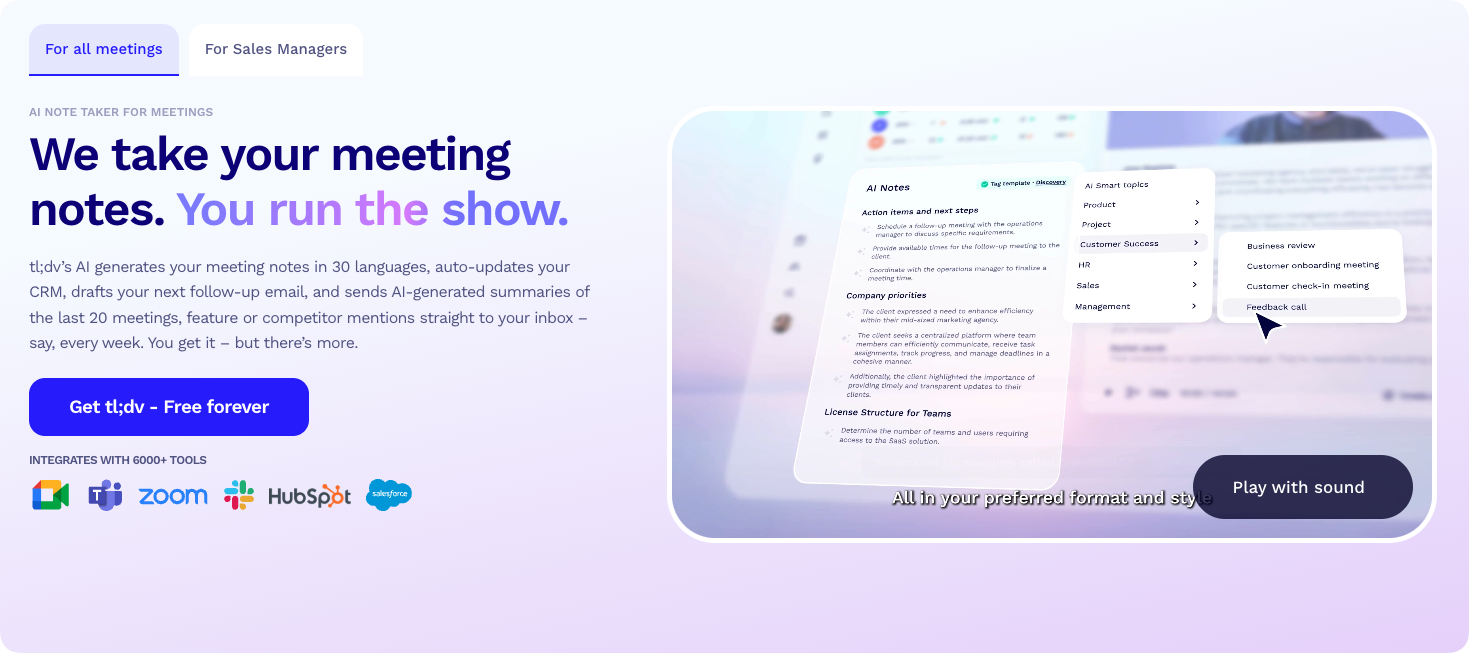
Tl;dv is a meeting recording and transcription tool designed to simplify the process of capturing and referencing important discussions. It offers a range of features aimed at streamlining meeting documentation and making information easily accessible.
Pros
To start, let’s talk about the key points that make Tl;dv a great option for your team:
- AI-powered transcription and summarization: Tl;dv can transcribe meetings in 20+ languages and automatically summarize the topics discussed, highlighting key moments with AI.
- Integration with other platforms: It integrates well with platforms like Notion, Slack, HubSpot, and CRMs such as Salesforce.
- User-friendly interface: It's noted for its ease of use and can suit sales reps who need searchable meeting records without a complex rollout.
- Automatic speaker recognition: Tl;dv can identify multiple speakers and break this down into the transcript itself.
- Video clip creation: Tl;dv allows users to create bite-size videos containing meeting insights, which is useful for sharing key moments.
Cons
Now let’s look at where Tl;dv might be lacking in certain areas:
- No screen recording: Tl;dv is designed to record meetings and transcribe audio. It doesn’t work as a holistic tool for synchronous and asynchronous video.
- No real-time highlighted moments: Tl;dv doesn’t allow you to pin key moments during meetings.
- Basic collaboration features: Tl;dv does allow your team members to share videos between them, however, it doesn’t support video annotation, thread creating, or polls like some alternatives do.
- No sentiment analysis: Enterprise-level products like Claap or Gong break down the word selection and tone of speakers in calls, offering a detailed look at not just what happened in the meeting, but how it happened.
- Not an adequate video wiki: Tl;dv does store all your videos for you, however it doesn’t act as a suitable home for your videos. It is designed to be integrated with other tools and have videos hosted there.
- Limited data enrichment: Can only populate open text fields, not structured ones such as dropdowns, multi-selects, or numeric fields, limiting automation and reporting.
- HubSpot integration limitations: Enrichment works only at the deal or company level. Contact-level data is left out.
- Reliability concerns: Performance is inconsistent, disrupting daily workflows.
- Premature feature releases: New features are launched before they’re fully stable or usable.
Pricing
Tl;dv offers four plans: Free, Pro, Business, and Enterprise.
Pro costs $18 per seat per month billed annually or $29 billed monthly. Business costs $59 per seat per month billed annually or $98 billed monthly. Both include unlimited recordings and transcripts, while Enterprise adds custom features and pricing. Tl;dv also advertises integrations with 5000+ tools.
tl;dv free plan
- Unlimited recordings
- Unlimited transcripts
- 20+ languages
- AI summaries
- Speaker recognition
- Slack integration
- Viewing notifications
Top 10 tl;dv alternatives
1. Claap: best all-in-one platform for sales teams
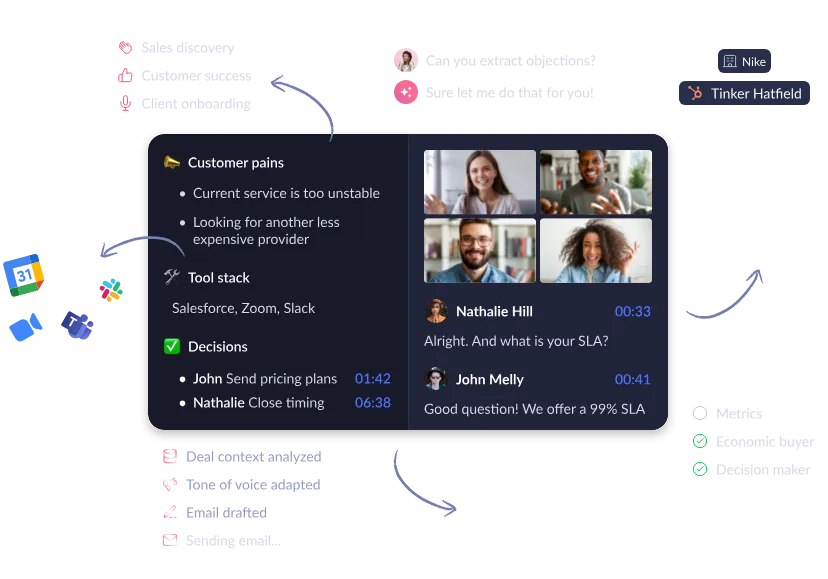
Claap is a conversation-intelligence platform built for the AI agent era. It records sales conversations, enriches the CRM, activates built-in or external AI agents through MCP, and gives managers coaching insights grounded in real calls.
Why does Claap beat tl;dv for sales teams?
Saves 30 minutes per call. Claap automates notes, CRM enrichment (HubSpot, Salesforce, Attio), and personalized follow-up emails. Tl;dv stops at transcription, so you still do the manual work.
Customizable for your sales process. Unlike Tl;dv's rigid templates, Claap adapts to MEDDIC, BANT, SPICED, or custom frameworks. Smart Tables analyze multiple calls at once to spot patterns.
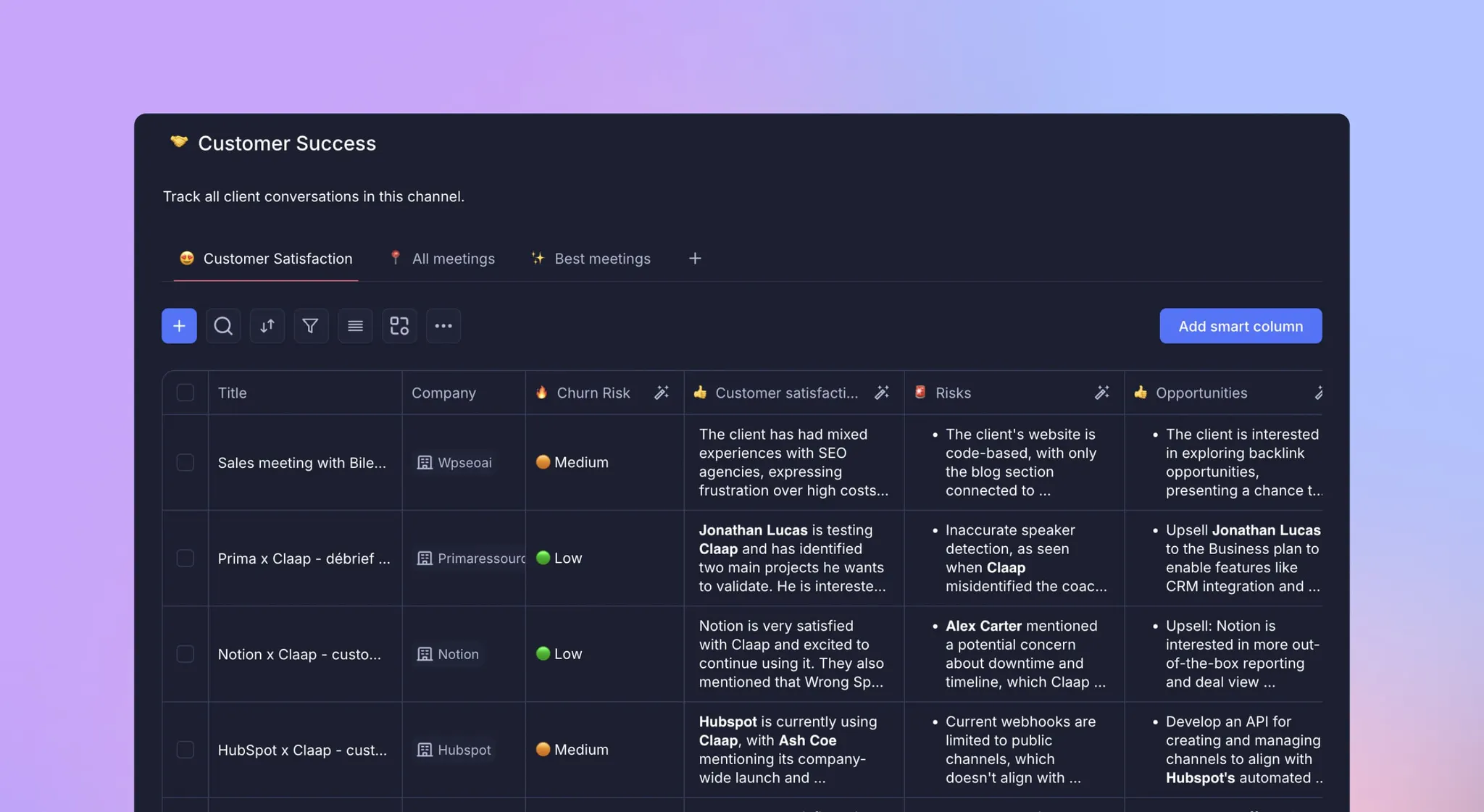
Sales coaching built in. Advanced coaching modules track talk ratios, objection handling, and performance. Managers get actionable insights without watching every call.
Meeting and async video in one tool. Claap combines meeting recording with screen recording for demos, deal reviews, and pipeline updates. No juggling multiple tools.
AI agents fueled by sales conversations. Ask questions like “What objections came up in the last five calls?” or connect your own agents through MCP so they can use real conversation context.
Real results
- Surfe: Shortened sales cycle by 10 days
- TenderApp: 66% win rate uplift (9% to 15%)
- Ronspot: 26% higher deal value
Pricing: Free (10 videos/300 min), Power Recorder (€24/month unlimited), Business (€48/month with full sales intelligence), Enterprise (custom).
Try Claap free or book a demo.
2. Gong: best for large enterprise
Gong is a heavyweight revenue-intelligence platform. It analyzes customer interactions across calls, emails, and meetings to provide deal intelligence, forecasting, and coaching.
Pros: Complete revenue intelligence platform, AI conversation analysis, customized coaching, multi-channel deal tracking.
Cons: Expensive ($40k+ annually for mid-sized teams), weeks to install, complex interface, sales-centric only.
Who it's for: Large enterprises (100+ reps) with big budgets needing complete revenue operations.
Gong pricing: Estimated at roughly $1,200–$1,600 per seat annually with a roughly 15-seat minimum, creating an $18,000–$24,000 annual seat floor before mandatory platform and implementation fees. Gong does not publish pricing or offer a free trial.
3. Fathom: best free alternative
Fathom is the go-to free alternative with unlimited calls and transcripts.
Pros: Free plan, simple interface, meeting highlights, full transcripts with speaker ID, easy setup.
Cons: Around 25 supported languages, no screen recording, no advanced coaching or analytics.
Who it's for: Individual sales reps or small teams on a tight budget.
Pricing: Free forever for unlimited recordings and transcriptions. Team costs $19/user monthly or $15 with annual billing, while Business costs $34 monthly or $25 annually.
4. Fireflies.ai: best for language coverage
Fireflies delivers transcription across 100+ languages and offers searchable meeting records, summaries, and integrations.
Pros: 100+ languages, AskFred AI to query meetings, affordable annual Pro plan, strong integrations.
Cons: No screen recording, limited collaboration features, basic coaching compared to Claap.
Who it's for: Teams prioritizing transcription and broad language support.
Pricing: Free (400 minutes of team storage), Pro ($10/seat monthly billed annually or $18 monthly), Business ($19/seat annually or $29 monthly), Enterprise ($39/seat monthly, annual only).
5. Grain: best for HubSpot users
Grain is built specifically for HubSpot with deep CRM integration, automatic deal association, and visual pipeline management.
Pros: Excellent HubSpot integration, deal tracking, meeting highlights, affordable.
Cons: HubSpot-focused (limited value for other CRMs), no screen recording, fewer languages.
Who it's for: Sales teams living in HubSpot.
Pricing: Starter ($19/seat monthly or $15 annually), Business ($39/seat monthly or $29 annually), Enterprise (custom).
6. Modjo: best for European enterprise
Modjo is a French-based platform built for GDPR compliance with European data hosting and strong Salesforce integration.
Pros: GDPR compliance by design, robust Salesforce integration, enterprise security (SOC 2).
Cons: Sales-led process (no self-serve), higher price point, less flexible AI than Claap.
Who it's for: European enterprises with strict compliance requirements.
Pricing: Custom enterprise pricing (not published).
7. Avoma: best for customer success
Avoma focuses on customer success and account management with agenda tracking, QBR management, and customer health tracking.
Pros: Agenda tracking, QBR features, multi-meeting customer analysis, collaboration tools.
Cons: Not sales-optimized, limited customization, no screen recording.
Who it's for: Customer success teams and account managers.
Pricing: Plans start at roughly $19 per user per month. Higher-tier pricing and free-plan availability should be confirmed directly with Avoma.
8. Otter.ai: best for mobile and audio
Otter focuses on audio transcription and mobile use with real-time transcription and slide capture.
Pros: Free plan, user-friendly, real-time transcription, slide capture, Otter AI Chat.
Cons: No video recording, limited meeting analytics, non-customizable transcripts, privacy concerns.
Who it's for: Individual users needing mobile transcription.
Pricing: Free (300 min/month), Pro ($16.99/user monthly or $8.33 annually), Business ($30/user monthly or $19.99 annually), Enterprise (custom).
9. Jamie: best for privacy without a bot
Jamie records meetings locally without sending a bot, avoiding the awkward “AI assistant has joined” announcement.
Pros: No bot joining, privacy-first, works offline, cross-platform (Mac/Windows).
Cons: Limited features, lower accuracy than cloud-based tools, no video, fewer integrations.
Who it's for: Sales reps prioritizing discretion and privacy during customer calls.
Pricing: Free (10 meetings per month with a 30-minute cap), Plus (€25/month), Pro (€47/month), Team (€39/seat/month), Executive (€99/month). Annual billing is about 17% cheaper.
10. Reduct: best for live transcription
Reduct provides real-time transcription in 90+ languages with collaborative video editing and analysis tools.
Pros: Real-time Live Capture, 90+ languages, advanced search, collaborative Videoboard, transcript tagging.
Cons: No screen recording, no automated summaries, no free plan (14-day trial only).
Who it's for: Teams that need live multilingual transcription and collaborative video analysis.
Pricing: Standard starts at $30 per user per month. Advanced and Enterprise prices should be confirmed directly with Reduct.
How does Claap compare with the alternatives?
Claap vs. Gong: Gong is comprehensive but costs $40k+ and takes weeks to install. Claap focuses on speed, adoption, fair pricing, and AI agents that can use sales-conversation context through MCP.
Claap vs. tl;dv: tl;dv gives you transcripts. Claap adds automated CRM updates, follow-ups, multi-call insights, coaching, and AI-agent activation.
Claap vs. Modjo: Claap offers self-serve onboarding, flexible AI templates, CRM enrichment, coaching, and MCP connectivity for external agents.
Claap vs. Fireflies: Fireflies is a meeting recorder and transcription tool. Claap is a conversation-intelligence platform that enriches CRMs, provides coaching, generates follow-ups, and activates AI agents.
Claap vs. Fathom: Fathom's free plan is useful for individual reps. Sales teams that need CRM enrichment, coaching, and multi-call analysis should consider Claap.
How do you choose the right tool?
Choose based on the workflow you need after the call, then compare language coverage, CRM support, billing terms, and rollout complexity.
By budget
- $0: Fathom or Fireflies free tier
- $10–25: Fireflies, Grain, Otter, or Claap
- $40–50: Claap Business or Jamie Pro
- Enterprise: Claap, Gong, or Modjo
By primary need
- Conversation intelligence, sales automation, and AI agents: Claap
- Enterprise forecasting (100+ reps): Gong
- Free unlimited transcripts: Fathom
- 100+ languages: Fireflies
- HubSpot integration: Grain
- GDPR-focused enterprise deployment: Modjo
- Privacy without a meeting bot: Jamie
Quick decision
- Budget constraint? Choose Fathom.
- Broad language coverage? Choose Fireflies.
- Sales intelligence and AI-agent activation? Choose Claap.
- Large enterprise forecasting? Compare Gong, Claap, and Modjo.
FAQ
What is the best tl;dv alternative for sales teams in 2026?
Claap is the best tl;dv alternative for sales teams that need CRM enrichment, coaching, multi-call analysis, and AI agents fueled by sales conversations. It supports HubSpot, Salesforce, and Attio and can connect external agents through MCP.
How much does tl;dv cost in 2026?
tl;dv has four plans: Free, Pro at $18 per seat per month billed annually or $29 monthly, Business at $59 annually or $98 monthly, and Enterprise with custom pricing. The free plan includes unlimited recordings and transcripts.
What is the cheapest tl;dv alternative?
Fathom offers a free plan with unlimited recordings and transcriptions. Fireflies also has a free plan, while its Pro plan costs $10 per seat per month with annual billing.
Which tl;dv alternative supports the most languages?
Fireflies supports 100+ languages, Claap supports 99+, and Reduct supports 90+. tl;dv supports 20+ languages.
Is there a tl;dv alternative that records without a bot joining the call?
Yes. Jamie records locally without sending a bot into the meeting.
What is the best tl;dv alternative for HubSpot users?
Grain is built around deep HubSpot integration and automatic deal association. Claap is another option for HubSpot teams that also need CRM enrichment, coaching, and multi-call analysis.
Conclusion
The right tl;dv alternative depends on what you need:
- Complete sales workflow: Claap
- Enterprise revenue intelligence: Gong
- Free unlimited transcripts: Fathom
- Language coverage: Fireflies
- HubSpot integration: Grain
- Privacy: Jamie
For most sales teams, Claap hits the sweet spot: more powerful than basic recorders, more affordable than legacy enterprise tools, and built to turn sales conversations into CRM updates, coaching, follow-ups, and context for AI agents.
FAQ
What is the best tl;dv alternative for sales teams in 2026?
Claap is the best tl;dv alternative for sales teams that need CRM enrichment, coaching, multi-call analysis, and AI agents fueled by sales conversations. It supports HubSpot, Salesforce, and Attio and can connect external agents through MCP.
How much does tl;dv cost in 2026?
tl;dv has four plans: Free, Pro at $18 per seat per month billed annually or $29 monthly, Business at $59 annually or $98 monthly, and Enterprise with custom pricing. The free plan includes unlimited recordings and transcripts.
What is the cheapest tl;dv alternative?
Fathom offers a free plan with unlimited recordings and transcriptions. Fireflies also has a free plan, while its Pro plan costs $10 per seat per month with annual billing.
Which tl;dv alternative supports the most languages?
Fireflies supports 100+ languages, Claap supports 99+, and Reduct supports 90+. tl;dv supports 20+ languages.
Is there a tl;dv alternative that records without a bot joining the call?
Yes. Jamie records locally without sending a bot into the meeting.
What is the best tl;dv alternative for HubSpot users?
Grain is built around deep HubSpot integration and automatic deal association. Claap is another option for HubSpot teams that also need CRM enrichment, coaching, and multi-call analysis.