Best revenue intelligence software: 10 platforms for 2026
Under 100 reps, your forecast already lives in the CRM. What it lacks is evidence from calls on each deal. Ten revenue intelligence platforms compared on that, on forecasting and on what they cost.


Updated November 9, 2026.
Revenue intelligence software overview
- Gong is best for revenue teams of 50 reps and more that want calls, deal boards and the forecast from one vendor.
- Clari Forecast, now sold by Salesloft, is best for enterprise CROs who run roll-up forecasts across many teams on Salesforce.
- Salesforce Revenue Intelligence is best for Sales Cloud teams that want pipeline inspection without adding a vendor.
- Claap is best for teams of 5 to 100 reps that want every deal read from its calls and emails, with the answers written into HubSpot or Salesforce fields.
- Avoma is best for small teams that want a simple forecast at a published price.
- Backstory, formerly People.ai, is best for enterprises whose forecast suffers from missing activity data in the CRM.
Under 100 reps, buy deal evidence before a forecast roll-up: your forecast already lives in HubSpot or Salesforce, and what nobody trusts is the deals inside it.
Forecasting is hard everywhere. Only 7% of sales organizations reach a forecast accuracy of 90% or higher, and 69% of sales operations leaders say forecasting is getting harder, according to Gartner's sales practice in Demand Gen Report, March 2025.
The usual answer is a forecasting platform. But in most teams below 100 sellers, the roll-up is the part that already works. The weak part is the deal: a stage moved too early, a close date nobody checked, a confidence percentage typed on a Friday.
So this guide compares the 10 revenue intelligence platforms US teams shortlist, on two jobs: rolling the pipeline up into a number, and reading each deal from what the buyer said.
Revenue intelligence platforms at a glance
Prices below are for the cheapest setup that reads deals or forecasts, add-ons included. They buy different jobs: Claap's and Sybill's cover deal reading, Avoma's includes a forecast, and Salesforce's sits on top of a Sales Cloud license.
| Tool | Best for | Forecast roll-up | Reads calls and emails | Price to do the job |
|---|---|---|---|---|
| Gong | 50+ reps, one vendor for calls and forecast | Yes, Gong Forecast (separate product) | Yes | On request, per user plus a platform fee. Median contract $55,333 a year (Vendr) |
| Clari Forecast (Salesloft) | Enterprise roll-ups on Salesforce | Yes, core product | Through Salesloft Conversations | On request. Median contract $76,000 a year (Vendr) |
| Salesforce Revenue Intelligence | Sales Cloud teams | Forecast insights on Sales Cloud | No, reads CRM data | $220 per user per month, on top of Sales Cloud |
| Claap | Teams of 5 to 100 reps on HubSpot or Salesforce | No | Yes, writes answers into CRM fields | $60 per seat per month, billed yearly (Business) |
| Revenue.io | Salesforce teams that sell by phone | Sales forecasting module | Yes, dialer calls | Custom quote, per seat |
| Backstory (ex-People.ai) | Enterprises with activity gaps in the CRM | Forecast change views | Activity capture | Usage-based, on quote. Median contract $24,480 a year (Vendr) |
| Revenue Grid | Salesforce teams on Outlook or Gmail | Pipeline risk in the top package | Activity capture, meeting notes | On quote |
| Aviso | Enterprises that want forecast-first | Yes, core product | Yes | On quote. Median contract $73,662 a year (Vendr) |
| Avoma | Small teams on a budget | In the Revenue Intelligence add-on | Yes | $48 per seat per month, billed yearly ($19 seat + $29 add-on) |
| Sybill | Small teams that want deal summaries and CRM autofill | No roll-up described | Yes | $90 per user per month, billed yearly (Business) |
Prices are each vendor's own pricing page on November 9, 2026 (Gong, Salesforce, Claap, Revenue.io, Backstory, Revenue Grid, Aviso, Avoma, Sybill); median contracts are Vendr's purchase data (Vendr).
Where a sales forecast actually breaks
On our own sales calls, 44% of the buyer teams who described their forecast run it in HubSpot or Salesforce, from deal stages and the rep's judgment (Claap call data, October 2025 to October 2026). These are one sales team's calls, so read the shares as directional.
The number itself is rarely the complaint. A commercial operations lead at a US healthcare-training company described the field her forecast rests on: "We have deal stages, um, but then we also have this qualitative field that we call S for B forecast. And it's basically like the percent confidence the salesperson is that this deal is going to close." In the weekly review, she added, "inevitably on the call, someone's like, oh, that should have moved out to next quarter."
What buyers ask for is a second opinion on each deal. 69% of the buyer teams wanted call and email evidence to challenge the forecast, and 25% said their deals slip on timing (Claap call data, October 2025 to October 2026). A sales leader at a B2B data and research company put the timing problem plainly: "People have a good handle as to whether or not the deal is going to happen or not, but they don't have a good handle of time scales."
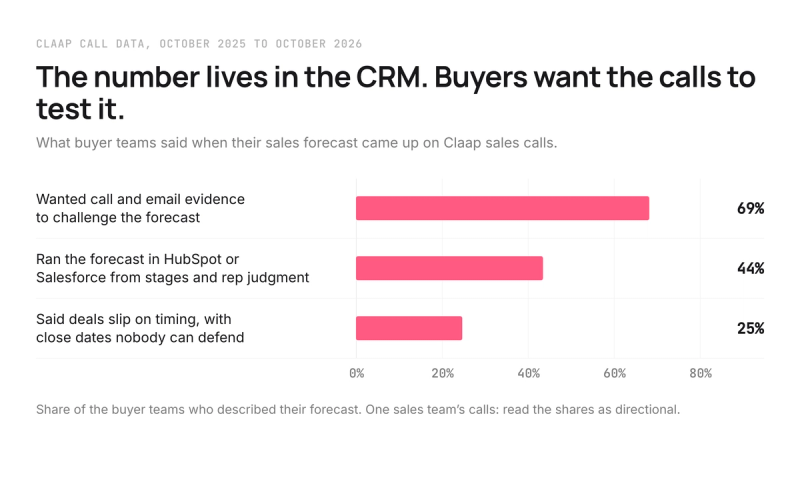
The CRM holds the data and nothing reads it. A sales operations lead at a French financial-services firm described Salesforce in one line: "It's a dumping ground, but there's no qualitative analysis on top of it."
So before you pick a platform, check where your gap is:
- Pick a forecast-first platform when the deals are well documented and the roll-up across teams, regions and quarters is what eats your week.
- Start with deal evidence when stages, close dates and confidence fields are typed by reps and nobody checks them against the calls, because a better roll-up of the same fields gives you the same wrong number faster.
- Use your CRM's native forecast when you run one team and one pipeline. HubSpot and Salesforce both ship one.
This advice is wrong if you run several sales teams across regions and your CRM data is already clean: then the roll-up is the bottleneck, and Clari Forecast, Aviso or Gong Forecast are built for it.
How we built this comparison
We kept the platforms US revenue teams most often shortlist for revenue intelligence and compared them on five criteria: whether they roll the pipeline up into a forecast, whether they read calls and emails at deal level, whether they write back to the CRM, what AI agents can do with the data through an MCP server, and the price to do the job. Ratings come from each tool's G2 page, and every price and feature links to the vendor's own page.
Important note. Chorus is part of ZoomInfo and has no standalone G2 listing, and ZoomInfo rates 1.6 out of 5 from 341 reviews on Trustpilot, so we left it out. Terret, the new name of BoostUp, is a credible forecast-first tool for mid-market Salesforce teams; it sits close to Aviso, so we kept Aviso.
A quick note: Claap is our product. To keep this comparison fair, we relied on third-party reviews and linked every major claim to its source.
1. Gong, best for revenue teams of 50 reps and more
Gong is the safe pick above 50 reps with a RevOps team and budget: calls, deal boards and Gong Forecast from one vendor. Under that size, the platform fee buys more than most teams will use.
Who Gong works best for
Teams on Salesforce or Dynamics where RevOps runs a weekly forecast call and managers coach from recorded calls.
Gong overview
Gong records calls and emails, turns them into deal boards with risk warnings, and sells Gong Forecast as a separate product for roll-ups and AI predictions (Gong Forecast).
Gong pricing
Gong prices per user plus a platform fee based on the number of users, on request (Gong's pricing page). The median Gong contract is $55,333 a year across 1,157 purchases (Vendr).
Gong integrations
Salesforce, HubSpot and Microsoft Dynamics. Its MCP server is read-only: it returns summarized insights, no transcripts, and "does not create, update, or delete data in Gong or the CRM" (Gong help center).
Gong pros and cons
Pros:
- Calls, deal boards and forecast in one product family.
- Forecast snapshots that let RevOps check accuracy over time.
- Large integration ecosystem.
Cons:
- No public price, and contracts are yearly.
- Read-only MCP for AI agents, with no transcripts.
What G2 reviewers say about Gong
Gong rates 4.7 out of 5 from 6,787 reviews on G2.
- "I also really appreciate Gong’s forecast snapshot reporting, which lets me dig in and more closely analyze our forecast accuracy." Senior manager, revenue operations, mid-market, September 2026.
- "Dashboard Analytics is frustrating because dashboard-level filters are often ignored by fixed widgets, totals frequently don’t match the underlying drilldown records..." Verified user, market research, small business, October 2026.
2. Clari Forecast (Salesloft), best for enterprise roll-up forecasting
Clari Forecast is the reference for roll-ups across many teams on Salesforce. It is the wrong buy for a team whose CRM fields are unreliable, because it forecasts from them.
Who Clari Forecast works best for
Enterprise CROs and RevOps teams who run forecast calls across regions and want pacing, waterfall and inspection views.
Clari Forecast overview
Clari merged with Salesloft, and clari.com now redirects to salesloft.com. Clari Forecast keeps its name and its own login inside the Salesloft platform, next to Conversations and Deals (Salesloft).
Clari Forecast pricing
On request. The median Clari contract is $76,000 a year across 291 purchases (Vendr).
Clari Forecast integrations
Built for Salesforce, with Salesloft's cadences and conversation intelligence in the same suite. Salesloft's MCP server exposes Clari forecast and deal data to AI assistants.
Clari Forecast pros and cons
Pros:
- The most complete roll-up forecasting in this list.
- Inspection and snapshot history for forecast calls.
- Engagement, conversations and forecast from one company.
Cons:
- Highest median contract here.
- Separate logins across the Salesloft products.
What G2 reviewers say about Clari Forecast
Clari has no standalone G2 listing since the merger; its reviews sit on Salesloft's page, rated 4.5 out of 5 from 9,918 reviews on G2.
- "From an operations standpoint, Clari adds structure and consistency to forecasting in a way that’s hard to achieve with native Salesforce alone." Sales technology manager, mid-market, February 2026.
- "For small teams under 20 reps, ROI is hard to justify. [...] If your CRM is messy, Clari will be messy." Small-business reviewer, September 2026.
3. Salesforce Revenue Intelligence, best for Sales Cloud teams
Salesforce Revenue Intelligence is the right choice when you already pay for Sales Cloud and want pipeline inspection with no new login. It reads what reps type, so it inherits every gap in those fields.
Who Salesforce Revenue Intelligence works best for
Sales Cloud Enterprise or Unlimited customers with an admin who can build the dashboards.
Salesforce Revenue Intelligence overview
It adds revenue insights, forecast insights, pipeline inspection and a rep command center on top of Sales Cloud forecasting (Salesforce). Call and email analysis come from another product.
Salesforce Revenue Intelligence pricing
$220 per user per month, or included in the Max edition (Salesforce's pricing page).
Salesforce Revenue Intelligence integrations
Native to Sales Cloud; call data arrives through a conversation intelligence tool that writes into Salesforce.
Salesforce Revenue Intelligence pros and cons
Pros:
- No sync and no new vendor.
- Published price.
- Forecast views managers already know.
Cons:
- No conversation analysis on its own.
- Expensive per user for a module.
What G2 reviewers say about Salesforce Revenue Intelligence
Salesforce Revenue Intelligence has no standalone G2 listing, so there are no reviews of the module on its own.
4. Claap, best for teams of 5 to 100 reps that need deal evidence
Claap is the right pick when your forecast lives in HubSpot or Salesforce and the problem is the deals inside it. It does not compute a roll-up, so pair it with your CRM forecast.
Who Claap works best for
RevOps leads and sales managers who run the pipeline review from HubSpot or Salesforce and want qualification fields, risks and next steps filled without asking reps.
Claap overview
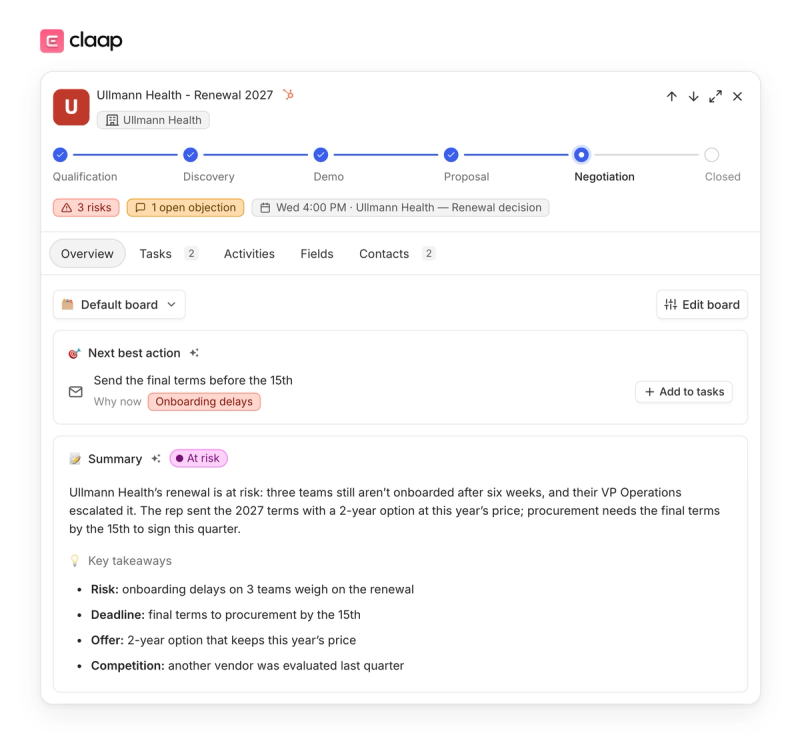
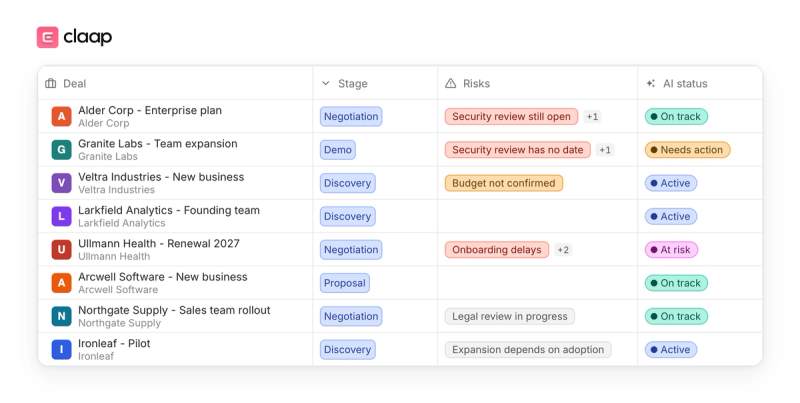
Claap records video calls, dialer calls and in-person meetings, reads emails, and writes an AI deal summary covering context, progress, decision process and main risk. When the calls say nothing on a point, it writes "timeline unclear" or "stakeholder not identified" instead of guessing (Claap revenue intelligence). Through CRM auto-complete, each answer lands as a typed value in a HubSpot or Salesforce field, with a sync mode per field so a value a rep typed is only overwritten if you choose it.
Claap pricing
Free Basic plan. Pro is $32 and Business $60 per seat per month, billed yearly; deal insights and CRM auto-complete are on Business, Enterprise is on quote (Claap's pricing page).
Claap integrations
HubSpot and Salesforce natively, custom objects included, plus Attio and Pipedrive for notes. Zoom, Google Meet, Teams and dialers such as Aircall and Ringover. The Claap MCP reads and writes deals, views and AI fields on every plan, including the free one.
Claap pros and cons
Pros:
- Every risk is tied to the call or email it came from.
- Typed CRM fields with a per-field overwrite rule.
- Published prices and an MCP that writes, on every plan.
Cons:
- Field mapping is HubSpot and Salesforce only; Attio and Pipedrive get notes.
- Deal insights need the Business plan.
- Smaller review base than Gong.
- No forecast roll-up of its own. If you want one in the call tool at a lower seat price, Avoma is the cheaper option.
What G2 reviewers say about Claap
Claap rates 4.6 out of 5 from 489 reviews on G2.
- "Claap’s AI summaries and CRM auto-completion save me around 20–30 minutes per meeting, and the bot-free recording keeps calls feeling natural." Small-business reviewer, October 2026.
- "The AI notes and transcripts aren't perfect. Names, product terms, and technical jargon sometimes come out wrong, so I usually give the notes a quick check before sharing them." Solution engineer, mid-market, September 2026.
5. Revenue.io, best for Salesforce teams that sell by phone
Revenue.io suits inside sales teams that live in Salesforce and make most of their calls from a dialer. Teams that sell mainly on video calls get less from it.
Who Revenue.io works best for
SDR and inside sales teams that make dozens of calls a day from inside Salesforce.
Revenue.io overview
A Salesforce-native platform for dialing, conversation intelligence, guided selling and sales forecasting, formerly known as RingDNA (Revenue.io).
Revenue.io pricing
Seat-based custom quote, scoped to team and plan (Revenue.io's pricing page).
Revenue.io integrations
Built inside Salesforce. No MCP server is documented.
Revenue.io pros and cons
Pros:
- Dialer, coaching and forecast in Salesforce.
- Activity logs straight to Salesforce records.
Cons:
- Salesforce only.
- No public price.
What G2 reviewers say about Revenue.io
Revenue.io rates 4.7 out of 5 from 581 reviews on G2.
- "I like the rev.ai feature where I can get feedback based on all of my activities on an opportunity." Reviewer, January 2026.
- "I wish the transcripts would pop up sooner, and that incoming calls would link to Salesforce records." Enterprise reviewer, May 2026.
6. Backstory (formerly People.ai), best for enterprises with activity gaps
Backstory fits when the forecast is wrong because emails, meetings and contacts don't reach the CRM. It is overkill for a team whose reps already log activity.
Who Backstory works best for
Organizations where sales, customer success and partner teams all talk to the same accounts and need one record of it.
Backstory overview
Backstory captures emails, calls and meetings, maps them to accounts and opportunities, and shows which deals are slipping and why, with forecast waterfall views (Backstory).
Backstory pricing
Usage-based: you pay to connect the people who talk to customers, then for the answers your team uses, on quote (Backstory's pricing page). The median contract is $24,480 a year (Vendr).
Backstory integrations
Salesforce, email and calendar systems, and an MCP server that brings deal context into AI assistants.
Backstory pros and cons
Pros:
- Deep automatic activity capture.
- Every viewer included, no per-login fee.
Cons:
- Usage pricing is harder to budget the first year.
- Fresh rebrand: many lists still say People.ai.
What G2 reviewers say about Backstory
Backstory rates 4.5 out of 5 from 630 reviews on G2.
- "PeopleGlass makes it so simple to update my opportunities and keep track of my forecast all in one place." Enterprise reviewer, June 2023.
- "while it saves me time, it also improves Salesforce hygiene allowing me to forecast more accurately." Vice president, enterprise sales, mid-market, November 2021.
7. Revenue Grid, best for Salesforce teams that need activity capture
Revenue Grid is a good fit for Salesforce teams working from Outlook or Gmail who first need clean activity data. Its pipeline risk module, Revenue IQ, only comes with the top package.
Who Revenue Grid works best for
Teams on Outlook or Gmail whose reps forget to log emails and meetings in Salesforce.
Revenue Grid overview
Revenue Grid captures customer interactions, syncs them to the CRM and adds meeting notes, an AI assistant and Revenue IQ for risks and next-best actions across the pipeline (Revenue Grid).
Revenue Grid pricing
On quote, in four packages; Revenue IQ is in RelationshipOS, the top package (Revenue Grid's pricing page).
Revenue Grid integrations
Salesforce, Outlook and Gmail; an MCP server from the Kora AI package up.
Revenue Grid pros and cons
Pros:
- Strong automatic email and calendar sync.
- Packages let you start with capture only.
Cons:
- No public price.
What G2 reviewers say about Revenue Grid
Revenue Grid rates 4.6 out of 5 from 597 reviews on G2.
- "It provides real-time visibility into the pipeline and customer engagement, which helps our teams track interaction history and make more informed decisions." Senior client services manager, mid-market, August 2026.
- "the outlook calendar syncing to XLR8 is not always accurate." Verified user, financial services, small business, June 2026.
8. Aviso, best for enterprises that want a forecast-first platform
Aviso is a credible alternative to Clari Forecast when you want forecasting depth and a vendor willing to buy out your current contract. Its setup is heavy for a single sales team.
Who Aviso works best for
Enterprise sales organizations replacing an incumbent forecast tool.
Aviso overview
A forecasting-first platform that added conversation intelligence, relationship intelligence and AI agents. Aviso claims 98% forecast accuracy, a vendor claim (Aviso).
Aviso pricing
On quote, with an offer to buy you out of a vendor contract (Aviso's pricing page). The median contract is $73,662 a year (Vendr).
Aviso integrations
Salesforce, email and calendar data. No MCP server is documented.
Aviso pros and cons
Pros:
- Forecasting depth close to Clari's.
- Contract buyout and migration offer.
Cons:
- Interface takes time to learn.
- No documented MCP server.
What G2 reviewers say about Aviso
Aviso rates 4.3 out of 5 from 994 reviews on G2.
- "I like the forecast tab because it helps me move from Excel models to a better AI-integrated source." Senior sales operations analyst, enterprise, May 2026.
- "the interface can feel a bit unintuitive at times, so it takes some extra effort to find what you’re looking for quickly." Enterprise reviewer, April 2026.
9. Avoma, best for small teams on a budget
Avoma is the cheapest published way to get a forecast next to call notes. Its forecast is an add-on and stays simple.
Who Avoma works best for
Small sales teams on Salesforce or HubSpot that want notes, scheduling and a basic forecast in one tool.
Avoma is the cheaper pick for a team that wants a forecast built into its call tool and doesn't need call answers written back into CRM fields: $48 per seat per month billed yearly for the forecast, against $60 for Claap Business, which flags deal risk from calls and feeds your CRM's forecast but computes no forecast roll-up (Avoma's pricing page).
Avoma overview
AI meeting notes, a scheduler and conversation intelligence, with AI deal risks, a methodology tracker, win-loss analysis and forecasting in the Revenue Intelligence add-on (Avoma's pricing page).
Avoma pricing
$48 per seat per month billed yearly for a forecast: a $19 Startup seat plus the $29 Revenue Intelligence add-on (Avoma's pricing page).
Avoma integrations
Salesforce and HubSpot, which the forecast requires, plus an MCP server.
Avoma pros and cons
Pros:
- Published prices for the forecast add-on.
- Notes, scheduling and deal risks in one tool.
Cons:
- Summaries still need a manual check.
- The forecast needs Salesforce or HubSpot.
What G2 reviewers say about Avoma
Avoma rates 4.6 out of 5 from 1,366 reviews on G2.
- "I like that Avoma integrates with HubSpot, allowing us to see our meeting notes from Avoma in HubSpot" CRM and systems consultant, small business, April 2026.
- "the summaries and action items are not always perfectly accurate, so they still need a quick manual review." Solution engineer, mid-market, March 2026.
10. Sybill, best for small teams that want deal summaries
Sybill suits small teams that want deal summaries and a few CRM fields filled after each call. It does not describe a forecast roll-up.
Who Sybill works best for
Founder-led and small sales teams that work in Slack and want to ask questions about a deal in plain English.
Sybill overview
Sybill records calls, builds deal summaries and lets reps ask questions about buyers, risks and pipeline (Sybill).
Sybill pricing
Business is $90 per user per month billed yearly and includes CRM autofill for 10 fields, the deal workspace and MCP access (Sybill's pricing page).
Sybill integrations
HubSpot, Salesforce, Slack and Teams, plus an API and MCP on Business.
Sybill pros and cons
Pros:
- Strong call and deal summaries.
- MCP and API on Business.
Cons:
- CRM autofill capped at 10 fields below Enterprise.
- Field filling needs the Business plan.
What G2 reviewers say about Sybill
Sybill rates 4.8 out of 5 from 150 reviews on G2.
- "an extremely accurate way to understand what happened on a call, what next steps are, and where the deal stands." Small-business reviewer, February 2023.
- "Wish they did more theme analysis like Gong does but not a huge deal" Head of marketing, small business, January 2024.
How to choose a revenue intelligence platform
- Ask for a trial on your own CRM. Deal views only mean something on your real stages and fields.
- Price the whole contract. Ask for the platform fee, the forecast module, seat minimums and the yearly increase in writing.
- Test on five deals in commit. Without asking the reps, read what the tool says about each deal, then check every risk against the call or email it came from.
- Check what your AI agents can do. Ask whether the MCP server returns transcripts, whether it can write to the CRM, and which plan it needs.
Conclusion
- Several teams and a clean CRM: the roll-up is your bottleneck, so budget for Clari Forecast, Aviso or Gong Forecast, and expect a five-figure yearly contract (Vendr medians above).
- Under 100 reps: fix the deals first. Read each one from its calls with Claap, Avoma or Sybill, and keep the forecast your CRM already gives you.
- Reps who don't log activity: capture comes first, with Backstory or Revenue Grid, before any forecast will hold.
- AI agents in the plan: check the MCP before you sign, because read-only access stops at questions.
For the call-level layer underneath, see our guide to conversation intelligence software.
Frequently asked questions
What is revenue intelligence software?
Revenue intelligence software combines sales calls, emails and CRM data to show which deals will close, which are at risk and why. Some platforms, such as Clari Forecast and Aviso, focus on rolling the pipeline up into a forecast. Others, such as Claap and Sybill, focus on reading each deal from what the buyer said and writing it into the CRM.
What is the difference between revenue intelligence and conversation intelligence?
Conversation intelligence analyzes each call: what was said, objections and how the rep ran it. Revenue intelligence rolls calls, emails and CRM changes up to the deal and the pipeline to judge whether deals will close. Conversation intelligence is the input that makes revenue intelligence trustworthy.
How much does revenue intelligence software cost?
Most enterprise platforms quote on request: Vendr's median contracts are $76,000 a year for Clari, $73,662 for Aviso and $55,333 for Gong. Salesforce lists Revenue Intelligence at $220 per user per month on its pricing page. On their pricing pages, Avoma's forecast costs $48 per seat per month and Claap's Business plan $60 per seat per month, both billed yearly.
What is the best revenue intelligence software for a small team?
Under about 100 sellers, the forecast in HubSpot or Salesforce plus a tool that reads each deal from its calls usually beats a forecast-first platform on cost and adoption. Claap, Avoma and Sybill publish their prices. Clari Forecast and Aviso are built for large, multi-team organizations.
Does Claap replace a forecasting tool like Clari?
No. Claap does not compute a forecast roll-up. It reads every deal from its calls and emails, flags risks and missing decision-makers, and writes those answers into HubSpot or Salesforce fields, so the forecast you already run rests on what buyers said.
Is Clari still a separate company?
No. Clari merged with Salesloft and clari.com now redirects to salesloft.com. Clari Forecast keeps its name as a Salesloft product, with its own login.
Which revenue intelligence platforms have an MCP server for AI agents?
Gong's MCP server is read-only and returns no transcripts. Claap's reads and writes on every plan, including the free one. Salesloft, Backstory, Avoma, Sybill and Revenue Grid also document one, Sybill and Revenue Grid on paid packages only.